

In operational environments where teams need to coordinate quickly, voice communication still plays a central role. This is where PoC, short for Push-to-Talk over Cellular, comes in.
PoC is a communication solution that enables instant push-to-talk communication over cellular networks and Wi-Fi, rather than relying only on traditional radio infrastructure. For organisations with distributed teams, multi-site operations, or a need for broader communication reach, PoC offers a practical way to support day-to-day coordination.
This article explains what PoC means, how it works, how it differs from traditional two-way radio, and what buyers should consider when evaluating a PoC solution.
Looking for a PoC solution for business operations?
Explore POCSTARS SolutionsQuick Overview
PoC stands for Push-to-Talk over Cellular, a communication model that delivers instant voice communication over 4G, 5G, and Wi-Fi networks.
It combines the push-to-talk experience of two-way radio with the broader reach of public mobile networks.
PoC is commonly used in security, transport, logistics, property, hospitality, utilities, and field operations.
When evaluating a PoC solution, buyers should look at deployment model, device support, dispatcher functions, and operational fit.
What Does PoC Mean?
PoC stands for Push-to-Talk over Cellular.
At its core, PoC combines the familiar push-to-talk communication experience of two-way radio with the network reach of 4G, 5G, and Wi-Fi. Instead of being limited to the coverage of a local radio system alone, PoC enables communication over public mobile networks, which makes it especially relevant for teams operating across wider areas.
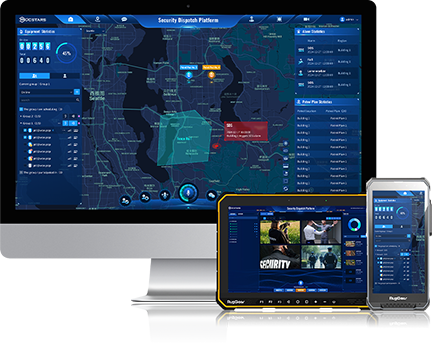
In business use, PoC may be accessed through dedicated PoC radios, smartphones, tablets, dispatcher consoles, and other connected terminals, depending on the platform.
How Does PoC Work?
A PoC system allows a user to press a push-to-talk button on a terminal, app, or device to start instant voice communication.
In a typical setup:
A user initiates a call from a PoC terminal or application.
The voice is transmitted over a cellular network or Wi-Fi connection.
The PoC platform manages user access, group communication, and call routing.
A dispatcher, if included, can help supervise communication and team coordination.
Depending on the solution, PoC platforms may also support functions such as one-to-one calls, group communication, dispatcher-based coordination, user and group management, location visibility, and messaging-related tools.
The exact feature set varies by system, but the overall purpose remains the same: to make team communication more immediate and easier to manage across daily operations.
Why Is PoC Used in Business Operations?
PoC is not simply about replacing one communication tool with another. Its value usually comes from how it fits real operational needs.
Wider communication reach
Because PoC works over cellular networks and Wi-Fi, it can support communication across multiple sites, cities, or regions more easily than a purely local radio setup.
Faster deployment
In many cases, PoC can be introduced without building a full traditional radio infrastructure first. This can make deployment more practical for organisations that need to get operations running quickly.
Flexible device options
PoC is not limited to one hardware form. Depending on the system, organisations may use dedicated terminals, mobile apps, dispatcher platforms, or a combination of these.
Easier coordination across teams
For operations involving supervisors, mobile workers, and control personnel, dispatcher-based communication can improve visibility and coordination.
Better fit for distributed operations
PoC is often relevant for organisations that do not operate from a single confined site, but across broader operational areas.
Where Is PoC Commonly Used?
PoC is widely associated with sectors where communication needs to be fast, practical, and easy to manage across mobile teams.
Security operations: enabling guards, supervisors, and control staff to stay in touch during routine patrols and incident response.
Transportation and logistics: supporting coordination between drivers, dispatchers, warehouse teams, and field personnel.
Property and facility management: helping maintenance, security, and operations teams communicate more efficiently across buildings or managed sites.
Hospitality: improving communication between front desk, housekeeping, maintenance, and security teams.
Utilities and field service: supporting mobile teams that need practical communication across dispersed service areas.
These are not the only applicable environments, but they reflect the kinds of operations where instant team communication and broad communication reach are especially valuable.
PoC vs Traditional Two-Way Radio
PoC and traditional two-way radio are related, but they are not the same.
Traditional radio systems are typically built around dedicated radio infrastructure and may be chosen where radio-specific coverage planning, control, or resilience requirements are central.
PoC, by contrast, uses cellular networks and Wi-Fi to deliver push-to-talk communication over a broader area. It is often considered when flexibility, faster rollout, and multi-site connectivity are more important factors.
This does not mean PoC should be presented as a universal replacement for radio. In practice, the right choice depends on the operational environment, communication requirements, deployment model, and budget.
A more accurate way to understand the difference is this:
Traditional radio is often infrastructure-led
PoC is often network-led
The better fit depends on the application.
Cloud PoC and On-Premises PoC
When evaluating PoC, deployment model matters.
Some PoC systems are delivered through a cloud-based architecture, which may suit organisations that want a more centralised and scalable deployment model.
Others may prefer on-premises PoC, especially when local system control, site-level deployment, or operational independence is a stronger priority.
This distinction is important because not all projects are the same. A nationwide workforce and a smaller site-level deployment may have very different needs. In some cases, a simpler locally deployed PoC system may be more suitable than a broader cloud-based model.
Need a PoC model that better fits your project scope?
Deployment requirements can vary significantly between site-level projects and broader network-based operations. Reviewing the deployment model early can help narrow the right solution path.
Contact POCSTARSPoC, PTToC, and MCX, What Is the Difference?
These terms are related, but they are not identical.
PoC is the broad term most commonly used in business communication contexts.
PTToC, or Push-to-Talk over Cellular, is essentially the full expression behind the abbreviation.
MCX usually refers to a broader mission-critical services framework and is typically discussed in a more standards-driven context.
For many readers, the practical takeaway is straightforward: PoC is commonly used to describe broadband push-to-talk solutions for operational communication, while MCX belongs to a different, more specialised framework.
What Should Buyers Look for in a PoC Solution?
When assessing a PoC solution, it helps to focus on practical fit rather than generic marketing claims.
What device types are supported?
Is the system cloud-based, on-premises, or both?
Is dispatcher functionality available?
Does the solution fit single-site or multi-site operations?
What level of management and coordination is needed?
Does the solution align with actual operational workflows?
These questions help narrow the gap between a general technology concept and a solution that is genuinely suitable for the intended application.
Final Thoughts
PoC has become an important communication approach for modern operations because it combines the immediacy of push-to-talk communication with the reach of cellular and Wi-Fi networks.
For many organisations, its value lies in practical deployment, flexible device options, and the ability to support communication across distributed teams.
The most useful way to understand PoC is not simply as a new name for radio, but as a communication model designed for operational environments where speed, coverage, and coordination all matter.
FAQ
What does PoC stand for?
PoC stands for Push-to-Talk over Cellular.
How does PoC work?
PoC delivers push-to-talk communication over cellular networks and Wi-Fi, with the platform managing users, groups, and communication control.
Is PoC the same as two-way radio?
No. PoC and traditional two-way radio are related, but they use different communication models and may suit different operational needs.
Can PoC be deployed locally?
Yes. Depending on the solution, PoC may be delivered through a cloud-based or on-premises deployment model.
Who typically uses PoC?
PoC is commonly used in security, transport, logistics, utilities, hospitality, field service, and other operations that require fast team communication.
Related Reading
Explore On-Premises PoC for Site-Level Deployment
Learn More About MCX Communication
Discover POCSTARS Communication Solutions
Last updated: 2026-04-17