

Correctional environments are built around control — controlled access, controlled movement, controlled procedures. Yet many facilities still rely on mobile devices that are only partially controlled in practice.
The risk is rarely obvious at first. A device can look “fine” on the surface while quietly drifting out of policy: settings change, permissions get disabled, apps behave differently from one device to the next, and compliance gaps appear without warning.
In high-security operations, that drift becomes more than an IT issue. It becomes a security and compliance exposure — and it can undermine frontline coordination when it matters most.
The overlooked risk: device drift creates blind spots in control
When something goes wrong with a device in a correctional setting, teams often focus on isolated incidents: a lost handset, an unauthorised app, or a misused camera.
But the more common problem is quieter and harder to track: devices fall out of alignment over time. The same device fleet, across shifts and officers, slowly becomes inconsistent — and inconsistency is where control breaks down.
Common drift patterns include:
permissions disabled during a shift and never restored
communication or reporting apps updated on some devices but not others
unknown background apps consuming resources and creating instability
devices configured differently across units, contractors, or sites
“one-off exceptions” that become permanent gaps in policy
Over time, these small changes create policy blind spots — the moments when a device behaves differently than the facility expects, and control becomes reactive instead of proactive.
Why device control is a frontline requirement, not an IT preference
In correctional operations, devices are not just tools for convenience. They often carry the workflows that support: incident reporting, team coordination, access procedures, and escalation pathways.
When devices are unmanaged or inconsistent, the impact shows up in operational reality: slower response, unclear accountability, fragmented communications, and higher exposure during audits or investigations.
That is why device management in correctional facilities should be treated as an operational control layer — not a background IT task.
How POCSTARS MDM helps keep devices aligned in correctional environments
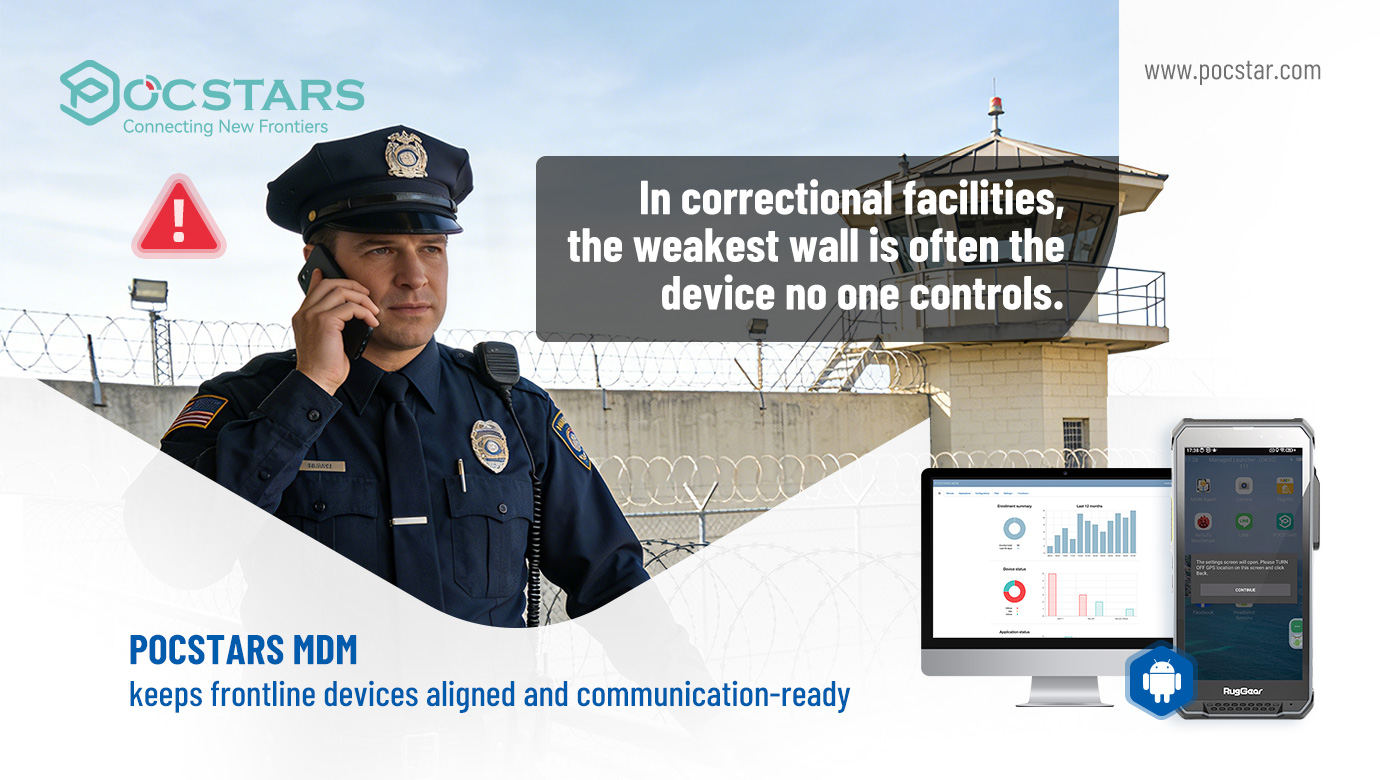
POCSTARS MDM is designed for communication-critical frontline operations. It helps facilities keep device fleets consistent, controlled, and ready for reliable coordination across shifts, teams, and sites.
1. Unified policy baseline across the fleet
Devices can be configured from the same policy baseline, reducing inconsistency across units and preventing drift from becoming the default state.
2. Role-based permissions and restricted capabilities
Different roles can receive different permission sets — so devices are equipped for what the job requires, without opening unnecessary capability or compliance risk.
3. App consistency and controlled updates
Communication and workflow apps remain consistent across devices, helping avoid “it works on mine” behaviours that disrupt frontline operations.
4. Remote lock and wipe for misplaced devices
If a device is lost or misplaced, it can be secured quickly to protect operational continuity and reduce exposure.
5. Real-time visibility into device readiness
Teams can identify misalignment early — before it turns into an operational disruption or a compliance issue.
Learn more about POCSTARS MDM here: POCSTARS MDM solution page
The outcome: fewer blind spots, stronger compliance, steadier frontline coordination
In correctional environments, the goal is not simply to “manage devices”. The goal is to ensure devices remain predictable — aligned with policy, consistent across shifts, and ready for reliable frontline coordination.
That is how device control strengthens the operational system: fewer unknown states, fewer compliance gaps, and fewer moments where the device becomes the weakest link.
Download the POCSTARS MDM Product Sheet
Need a concise one-page summary to share internally? Download the POCSTARS MDM product sheet for communication-critical environments.
Download PDFRelated reading
Ports: Why device drift disrupts frontline coordination — read the blog
Hazardous sites: How device management strengthens safety workflows — read the blog
This article is part of POCSTARS’ series on enterprise device management and frontline communication reliability.