

In hazardous environments such as chemical plants, refineries or gas processing sites, safety is built on layers: procedures, training, sensors, alarms, and – increasingly – digital communication and location tools. On paper, the safety chain looks complete. In daily operations, however, one weak link is often underestimated: frontline devices that are not properly managed.
Modern sites may invest heavily in push-to-talk over cellular (PoC), positioning systems and digital permits-to-work. Yet when an incident happens, communication can still break, or staff cannot be located quickly enough, not because the infrastructure is missing, but because the devices in people’s hands are misaligned with what the safety plan assumes.
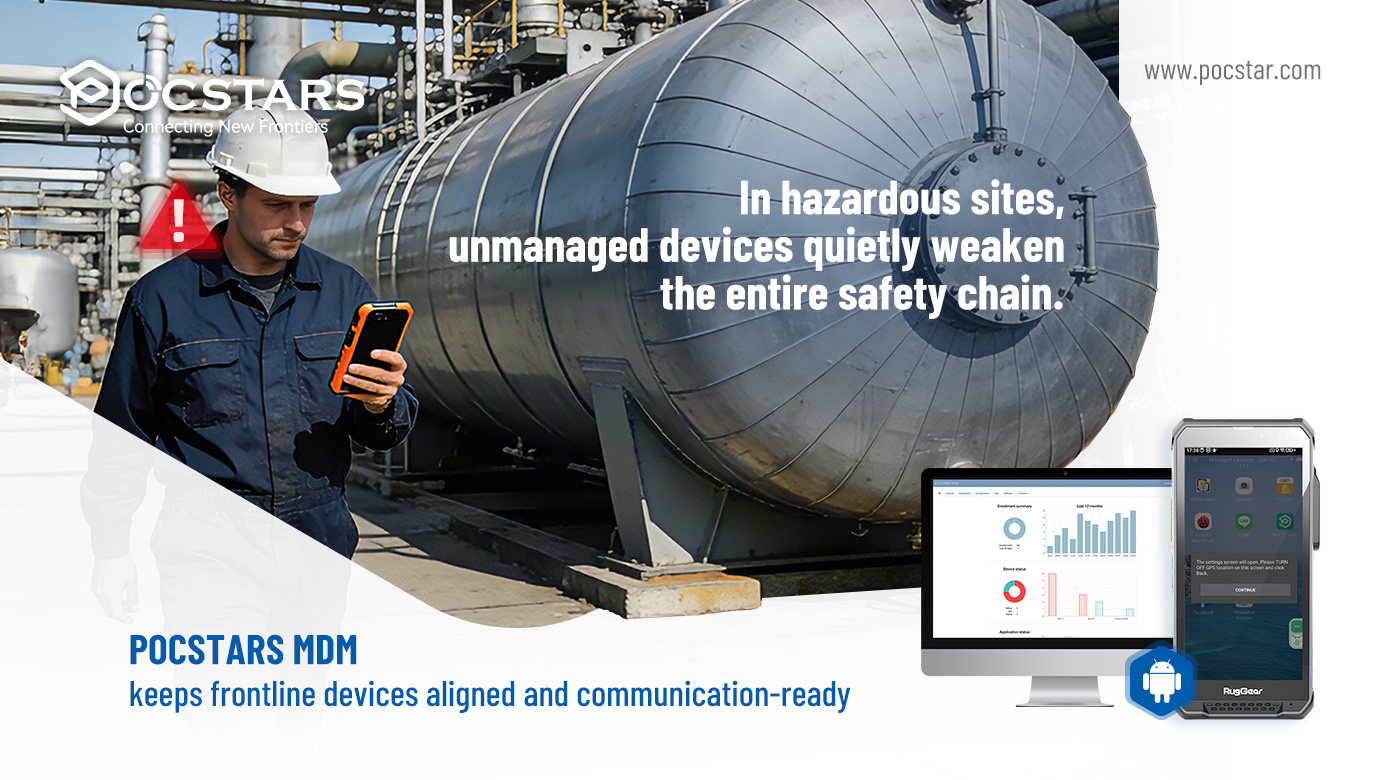
In hazardous sites, unmanaged devices quietly weaken the entire safety chain – long before anyone notices it on a report.
Looking for the full capabilities of POCSTARS MDM?
View the MDM Solution PageWhy hazardous operations now depend on digital communication and location
Hazardous operations used to rely almost entirely on radios, fixed alarms and visual supervision. Today, many sites are moving towards:
smartphones or rugged terminals for voice, data and checklists
digital forms for inspections and incident logging
indoor/outdoor positioning to locate staff and contractors
integrated PoC or MCX systems for group calls and emergency alerts
This shift brings clear advantages: richer information, faster escalation, and better traceability. But it also introduces a new dependency: if the devices are not in the expected state, the whole safety workflow can be slowed down or interrupted.
Safety teams may assume that “everyone has the app, everyone receives the alert, and everyone can be located”. In reality, that only holds true if devices remain aligned with safety policies – every day, on every shift.
Device drift: how small changes erode safety barriers
In many investigations, communication or location problems in hazardous areas are first blamed on:
weak coverage in a specific zone
a temporary network glitch
a missed configuration in the platform
But when operational details are reviewed, a different pattern often appears: devices themselves have drifted away from the expected configuration.
Typical examples include:
a location permission disabled during a previous troubleshooting step and never restored
a PoC or safety app updated on some devices but not on others
a user-installed utility app running in the background and consuming CPU or bandwidth
a device where camera or microphone access is partially blocked, affecting incident documentation
a terminal filled with cached data and logs, slowing down critical applications
None of these issues look critical in isolation. Together, they create safety blind spots: delayed alarms, missed calls, incomplete location data, or teams that cannot hear or respond as planned.
This device configuration drift in hazardous sites has become one of the most common – and most preventable – contributors to safety workflow failures.
Beyond radios: combining MDM, location and PoC for hazardous sites
In many high-risk facilities, three capabilities are now central to the safety architecture:
PoC or MCX for immediate group and individual voice communication
positioning systems to see where people and assets are, indoors and outdoors
MDM (Mobile Device Management) to keep those devices aligned with safety policies
Each component can bring value on its own. The real impact, however, appears when they work together:
PoC ensures the right people can speak and receive alerts in real time
location systems ensure safety teams know who is in which zone, especially in restricted or high-risk areas
MDM ensures that PoC and location apps are installed, updated, permitted and protected on every device
Without MDM, the other two layers can only deliver part of their potential. A location system cannot help if location is disabled on a subset of devices. An emergency group call loses impact if some terminals have been modified or overloaded.
How POCSTARS MDM supports safety-critical communication in hazardous sites
POCSTARS MDM (product page) is designed for environments where safety and communication are tightly linked. Instead of treating devices as generic smartphones, it allows organisations to manage them as safety tools with clear, enforced baselines.
1. Unified safety baselines across roles and zones
Devices used by inspection teams, control room staff and field operators can all be configured from a shared safety baseline, then adjusted by role or zone:
mandatory installation of PoC, location and safety apps
required permissions (e.g. location, microphone) enforced at device level
blocked access to non-essential or distracting applications
This reduces variation between shifts and makes it easier for HSE and operations to know what each device can do.
2. Role-based restrictions to support safety policies
Hazardous sites often have strict rules about where and how devices can be used. With POCSTARS MDM, organisations can:
allow or restrict camera use based on location or role
control USB, Bluetooth or other interfaces where needed
ensure only approved communication and inspection tools are available
This aligns device behaviour with existing safety procedures, rather than relying on individual habits.
3. Keeping PoC and location tools consistent and ready
Version mismatch is a common source of unexpected behaviour. POCSTARS MDM helps ensure that:
PoC and location apps remain at known, tested versions
critical apps are protected from removal or unauthorised changes
background activity from other applications does not interfere with communication
The goal is simple: when teams need to talk or locate someone, the device behaves as expected.
4. Remote actions and readiness visibility
In large industrial sites, it is not realistic to “collect all devices” whenever something needs to be adjusted. Through MDM, operations teams can:
lock or wipe a lost device remotely
push configuration changes without recalling terminals
see which devices are online, compliant and communication-ready
This shifts device management from reactive troubleshooting to proactive safety readiness.
A combined scenario: MDM, location and PoC during an incident
Consider a simplified example in a hazardous production area:
a gas detector triggers an alarm in a specific zone
the control room needs to see who is inside the affected area and which teams are nearby
a PoC emergency group call is initiated to reach all staff in and around that zone
supervisors need to confirm that staff have evacuated to the correct muster points
In this scenario, communication and location are only as reliable as the devices:
if location permissions are disabled on some terminals, evacuation visibility is incomplete
if PoC is not installed or updated everywhere, not everyone receives the instructions
if some devices have been heavily modified, audio quality or responsiveness may be degraded
With POCSTARS MDM in place, the site can enforce the required configuration for all safety-critical devices: the right apps installed, the right permissions enabled, and the right restrictions in place. This does not replace other safety layers, but it protects the part of the safety chain that lives in workers’ hands.
Practical steps for HSE and operations teams
For organisations operating hazardous sites, a practical starting point is to treat device management as a safety topic, not only an IT topic:
identify which roles rely on smartphones or terminals for safety-related tasks
define the “minimum safety configuration” those devices must always have
map how PoC, location and inspection tools are installed and maintained today
introduce MDM policies to keep that configuration consistent across shifts and contractors
establish simple readiness checks (e.g. device compliance dashboards) before major operations
The objective is not to add complexity, but to remove uncertainty. When devices are managed with the same discipline as other safety systems, the communication layer becomes more predictable and dependable.
Related reading: ports and device drift
Hazardous sites are not the only environments where unmanaged devices affect operations. For a port-focused perspective on device drift and frontline communication, you can read: Why ports need communication-ready devices — and how MDM prevents frontline communication failures
About POCSTARS MDM
POCSTARS supports communication-critical environments globally, from public safety and transportation to hazardous industrial sites. POCSTARS MDM extends this reliability to the device layer, helping organisations keep smartphones and terminals aligned with safety and communication requirements across every shift.
By combining MDM with positioning and PoC/MCX platforms, operators can turn general-purpose smart devices into dependable frontline tools that support daily operations, incident response and long-term digital safety programmes.
Download the POCSTARS MDM Product Sheet
Need a concise one-page summary to share intrnally? Download the POCSTARS MDM product sheet for communication-critical environments.
Download PDFThis article is part of POCSTARS’ series on enterprise device management and frontline communication reliability.