

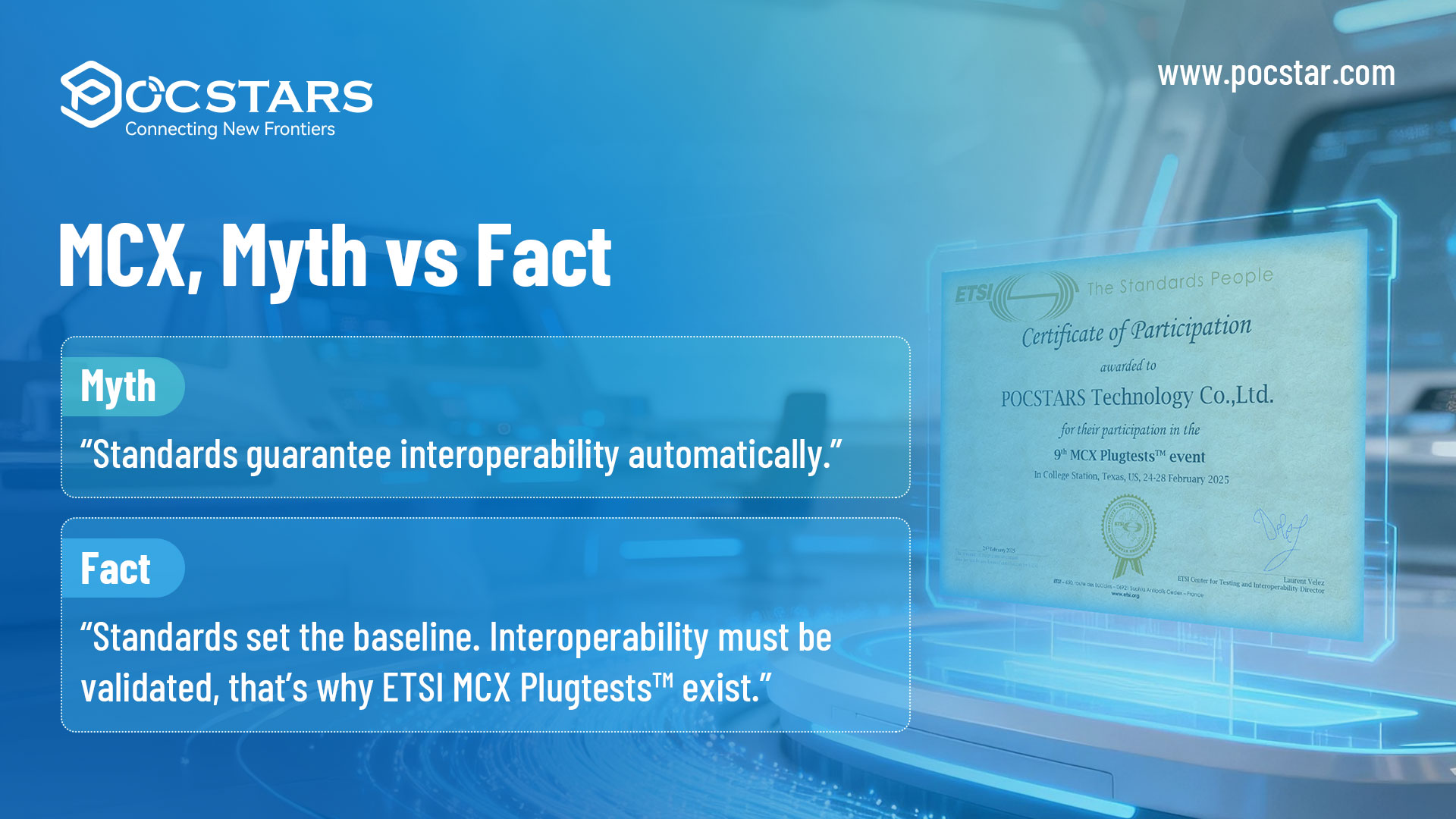
“Standards guarantee interoperability automatically.” This is one of the most common shortcuts in mission communications discussions, especially when people hear the phrase “standards based”.
Standards matter. They define a shared baseline that makes multi-vendor ecosystems possible. But in real MCX programmes, interoperability is not something teams assume, it is something they validate before scale.
This article explains why standards are a baseline rather than a guarantee, what “validation” means in practical terms, and why structured multi-vendor activities, including ETSI MCX Plugtests™, exist in the industry.
Exploring MCX capabilities and project readiness?
View the MCX Solution PageTL;DR
Standards set the baseline for MCX interoperability, but they do not make interoperability automatic.
In mission communications, interoperability is something teams validate before rollout, not something they assume.
Multi-vendor validation activities exist to reduce deployment risk and confirm predictable behaviour across ecosystems.
Myth vs Fact
Myth: “Standards guarantee interoperability automatically.”
This myth usually comes from a reasonable place. If multiple vendors implement the same standards, it can feel intuitive that systems should interoperate with minimal effort.
In practice, standards alignment is a starting point. Interoperability in the field depends on how implementations behave under real configurations, real workflows, and real integration boundaries.
Fact: Standards set the baseline, interoperability must be validated
Standards enable an ecosystem, but they do not remove the need for evidence. In MCX programmes, interoperability is typically validated through structured testing and multi-vendor verification before scale, because mission operations depend on predictable behaviour.
That is why industry validation activities exist, including ETSI MCX Plugtests™, to help confirm interoperability outcomes in realistic multi-vendor conditions.
Why “baseline” is not the same as “guarantee”
In mission communications, “it should work” is not a deployment strategy. A standards baseline is essential, but it does not eliminate differences in implementation, configuration, and integration scope.
Implementation behaviour varies: two systems can be standards-aligned and still behave differently in edge cases, feature options, or configuration defaults.
Real deployments have boundaries: device fleets, OS versions, network policies, identity and security rules, dispatch integration, and recording requirements all shape interoperability outcomes.
Operational success depends on predictability: mission users judge communications by stability and consistency, not by standards documents.
What “validation” means in MCX projects
Validation in this context is not a single checkbox. It is the process of proving interoperability and behaviour under the conditions that matter to the project.
Scope clarity: what must interoperate, between which systems, for which workflows.
Evidence selection: lab outcomes, multi-vendor verification, certification schemes, or field trial results, depending on project context.
Operational acceptance: predictable outcomes in group structures, call flows, dispatch integration points, and user procedures.
The goal is simple: reduce surprises before scale, and ensure interoperability requirements are owned as part of the programme.
Where POCSTARS fits
POCSTARS continues to develop MCX capabilities under MCSTARS. In real projects, interoperability expectations are typically validated through structured testing, and POCSTARS has participated in multi-vendor interoperability testing activities, including ETSI MCX Plugtests™.

Where ETSI MCX Plugtests™ fits in
Multi-vendor validation activities exist because interoperability is easier to prove in structured conditions than in live operations. ETSI MCX Plugtests™ is one example of an industry activity that supports interoperability verification in a multi-vendor context.
The practical takeaway is not “validation is optional.” It is the opposite: if interoperability matters, validation should be planned and evidenced before rollout.
Need a plain-English interoperability checklist for MCX evaluation?
Available on request.
Contact POCSTARSFAQ
Does “standards based” mean interoperability is guaranteed?
Not automatically. Standards provide a baseline, but interoperability still needs validation and evidence before rollout.
What is a practical first step to avoid interoperability surprises?
Make interoperability boundaries explicit, then agree what evidence is required before scaling beyond a controlled scope.
Where do multi-vendor activities fit into evaluation?
They support structured verification across ecosystems and can help reduce deployment risk before field scale.
Conclusion
Standards enable MCX ecosystems, but they do not guarantee interoperability automatically. Interoperability becomes real when it is validated through evidence and planned as a first-class requirement, not treated as an assumption.
If your organisation is evaluating MCX and wants a grounded discussion around interoperability boundaries and validation planning, share your deployment context and requirements, and we can help map a practical evaluation approach.
Related reading
MCX, Myth vs Fact: Not Just a PTT App, Standards and Interoperability
MCX Migration Reality: Why Roadmaps Are Phased, Not Overnight
Last updated: 2026-02-13