

Consumer chat apps have become part of everyday communication. They are familiar, easy to use, and convenient for sharing messages, voice notes, images, and location information. For simple conversations, they can work well.
However, when communication becomes part of field operations, the requirements are different. Teams may need to coordinate mobile staff, manage groups by role or location, contact multiple users instantly, monitor team status, and support dispatch decisions in real time.
This is where PoC, short for Push-to-Talk over Cellular, provides a different kind of value. The key question is not whether a chat app can send messages. The real question is whether the communication tool can support structured team coordination and operational management.
Looking for a communication solution built for field coordination?
Explore POCSTARS SolutionsQuick Overview
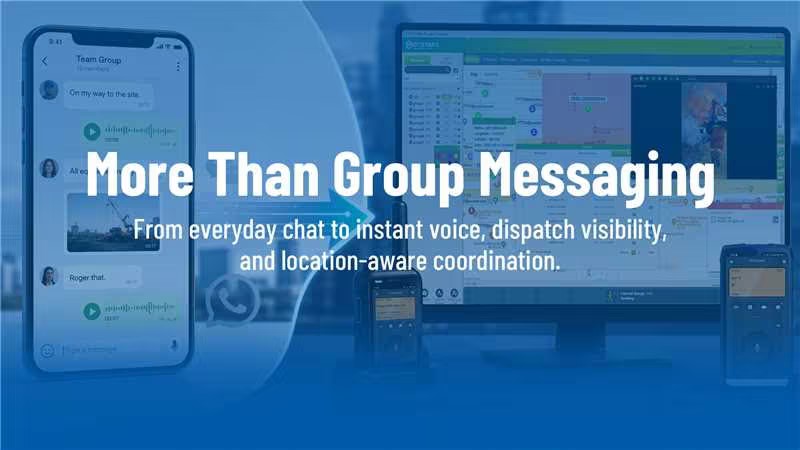
Consumer chat apps are useful for everyday communication, but field teams often need more than group messaging.
PoC is designed for operational communication, supporting instant push-to-talk, managed groups, dispatch visibility, and real-time location awareness.
The key difference is purpose: consumer chat apps connect people for conversation, while PoC helps organisations coordinate teams for field operations.
PoC is especially relevant when teams need faster voice communication, clearer user control, location-aware coordination, and structured dispatch support.
Consumer Chat Apps Are Built for Conversation
Consumer chat apps are designed mainly for personal and social communication. They help people stay connected, exchange information, and communicate in a flexible way. For many daily situations, this is enough.
In a workplace setting, chat apps may also support simple team discussions. A group can be created quickly, members can send updates, and information can be shared across smartphones.
But field operations often require more than flexible conversation. They require fast, controlled, and organised communication that matches how teams actually work on site, across routes, or across multiple service areas.
Field Operations Need More Than Group Messaging
In field operations, communication is closely connected to action. A dispatcher may need to reach a patrol group immediately. A supervisor may need to know which team member is closest to an incident. A manager may need to organise users by department, role, shift, or region.
These needs are different from everyday group messaging. In operational environments, communication often needs to answer several questions at once:
Who needs to receive this message immediately?
Which team members are available?
Where are the nearest users or resources?
Which group should be contacted for this task?
How can supervisors manage communication across teams?
How can user access and group structures be controlled?
When these questions matter, a general chat app may become difficult to manage. The issue is not that chat apps cannot communicate. The issue is that they are not built around dispatch, team structure, and operational workflows.
PoC Is Built for Operational Communication
PoC solutions are designed for team-based operational communication. Instead of opening a chat, typing a message, or sending a voice note, users can press a button and speak to a group instantly.
This push-to-talk experience is especially useful for field teams that need quick coordination during patrols, inspections, transportation, security operations, property management, service work, and emergency response.
With PoC, communication is not just a conversation between individuals. It becomes part of a managed communication system, where groups, users, locations, and dispatch functions can be organised according to operational needs.
Instant Voice Makes Coordination Faster
One of the main differences between PoC and consumer chat apps is the communication workflow. In a chat app, users often need to open the app, select a conversation, record or type a message, and wait for others to check it.
For field teams, this can be too slow in situations that require immediate coordination. Push-to-talk allows users to communicate with a group in real time, making it easier to share short, urgent, and action-oriented updates.
This does not mean every message needs to be urgent. It means that when speed matters, the communication process should be simple and direct.
Dispatch Visibility Helps Supervisors Manage Teams
Field communication is not only about what users say to each other. It is also about how supervisors and dispatchers manage teams.
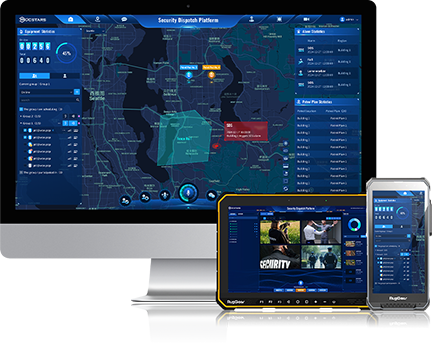
A PoC solution can support dispatch functions that help supervisors organise communication more clearly. Depending on the system setup and project requirements, dispatchers may be able to manage groups, communicate with users, monitor team status, and coordinate resources from a central interface.
This is an important difference from consumer chat apps. A chat group may allow people to talk, but it does not necessarily provide a structured dispatch view for operational management.
Location Awareness Adds Operational Context
In many field scenarios, knowing who is speaking is only part of the picture. Supervisors may also need to understand where team members are, which user is closest to a location, and how resources are distributed across a site or service area.
Consumer chat apps may allow users to share locations manually, but this is not the same as having location awareness as part of an operational communication workflow.
With real-time location awareness, dispatchers can gain better context for daily coordination. This can be useful for mobile teams, patrol tasks, service operations, property management, transportation, and other field-based environments.
Need more than group messaging for field teams?
POCSTARS PoC solutions support instant voice communication, dispatch visibility, real-time location awareness, and managed team coordination for operational environments.
Contact POCSTARSManaged Groups and User Control Matter
For small informal groups, a consumer chat app may be simple enough. But as a team grows, communication management becomes more important.
Organisations may need to create groups by department, role, project, region, or shift. They may need to add or remove users when staff change roles or leave the organisation. They may also need to control who can access certain groups or communication channels.
PoC systems are better suited to this kind of managed team communication. They can help organisations build communication structures that match their operational hierarchy, rather than relying on informal chat groups created by individual users.
Work Devices Should Not Always Depend on Personal Chat Accounts
Another practical concern is the separation between personal communication and work communication. Many consumer chat apps are connected to personal phone numbers or personal accounts.
For field operations, this can create management challenges. Staff may use personal devices, create unofficial groups, or keep work-related communication outside the organisation’s managed system. When people change roles or leave, it may also be harder to control access to previous communication groups.
A dedicated PoC solution helps organisations manage work communication more consistently. It supports a clearer boundary between personal messaging and operational communication.
PoC Is Not Just a Replacement for Chat Apps
It is important to be clear: PoC does not need to replace every communication tool in an organisation. Consumer chat apps may still be useful for general discussions, non-urgent updates, or informal communication.
The role of PoC is different. It is designed to support field communication where speed, group coordination, dispatch management, location awareness, and user control are important.
In other words, consumer chat apps connect people for conversation. PoC helps coordinate teams for operations.
When Should a Team Consider PoC?
A team may need PoC if communication is closely connected to daily operations, field response, or team coordination. It can be especially relevant when:
Team members work across different locations or routes.
Supervisors need to coordinate groups in real time.
Users need instant voice communication with one or more teams.
Location awareness is important for dispatch decisions.
Communication groups need to be managed by role, site, or department.
The organisation wants clearer control over work communication.
For industries such as security, transportation, logistics, utilities, property management, hospitality, construction, and public safety-related operations, these requirements are often part of daily work.
Where POCSTARS Fits
POCSTARS provides PoC communication solutions designed for field teams, mobile workers, and operational environments. The solution supports instant push-to-talk communication over cellular networks, helping teams stay connected across wider areas than traditional short-range communication methods.
Beyond instant voice, POCSTARS solutions can also support group communication, dispatch management, real-time location awareness, and connected operational workflows, depending on project requirements and deployment scenarios.
For organisations comparing consumer chat apps with PoC, the key difference is the purpose of the system. A chat app may be enough for simple conversation. A PoC solution is more suitable when communication needs to support team coordination, field visibility, and operational management.
Final Thoughts
Consumer chat apps are useful tools for everyday communication, but field operations often require more than group messaging.
Teams need communication that is fast, structured, manageable, and connected to operational context. PoC helps field teams move from informal conversation to managed coordination.
With instant voice, dispatch visibility, location awareness, and controlled group communication, organisations can build a more practical communication workflow for daily operations.
For field teams, the value of PoC is not simply that it allows people to talk. Its value lies in helping teams coordinate, respond, and operate more effectively.
FAQ
Why not just use a consumer chat app for field teams?
Consumer chat apps are useful for daily conversation, but field teams often need instant group voice, dispatch visibility, managed groups, user control, and location-aware coordination. These requirements are closer to operational communication than ordinary messaging.
What is the main difference between PoC and a chat app?
A chat app is mainly built for conversation. PoC is designed to support field coordination, including push-to-talk voice, group communication, dispatch management, and operational visibility.
Does PoC replace all chat tools?
Not necessarily. Consumer chat apps may still be useful for general discussion or non-urgent communication. PoC is more suitable when teams need fast, structured, and manageable operational communication.
Who should consider using PoC?
PoC can be relevant for security, transportation, logistics, utilities, property management, hospitality, construction, and other operations where mobile teams need fast communication and coordinated field management.
Does PoC support location awareness?
Depending on the solution and project setup, PoC platforms may support real-time location awareness to help dispatchers understand where team members are and coordinate resources more effectively.
Related Reading
Explore On-Premises PoC for Site-Level Deployment
Learn More About POCSTARS Geo-Location Solution
Last updated: 2026-05-11